Decomposing the 10-year Treasury yield with TIPS
Independent research note. Historical observations: January–December 2024. The breakeven measure below is a difference between constant-maturity par yields.
Between September 16 and December 31, 2024, the 10-year nominal Treasury yield rose 95 basis points. The 10-year real yield rose 70 bp, while the nominal-minus-real yield difference increased 25 bp. On that arithmetic, roughly 74% of the nominal move came from real yields.
Calling the entire selloff an inflation repricing would obscure most of the observed change. It would also treat breakeven inflation as a cleaner measure of expectations than the evidence supports.
Separate the nominal yield into two observable components
Treasury Inflation-Protected Securities, or TIPS, pay a fixed coupon rate on principal that adjusts with inflation. A nominal Treasury fixes its dollar payments. Subtracting a maturity-matched real yield from a nominal yield gives a common proxy for inflation compensation:
For this note, the inputs are FRED's DGS10 and DFII10, which report Treasury constant-maturity nominal and real yields.
| Observation date | Nominal yield | Real yield | Difference |
|---|---|---|---|
| June 28, 2024 | 4.36% | 2.08% | 2.28% |
| September 16, 2024 | 3.63% | 1.54% | 2.09% |
| December 31, 2024 | 4.58% | 2.24% | 2.34% |
From June 28 to September 16, the nominal yield fell 73 bp: 54 bp from the real-yield component and 19 bp from the breakeven proxy. The subsequent rise reversed both components, with a larger contribution from real yields.
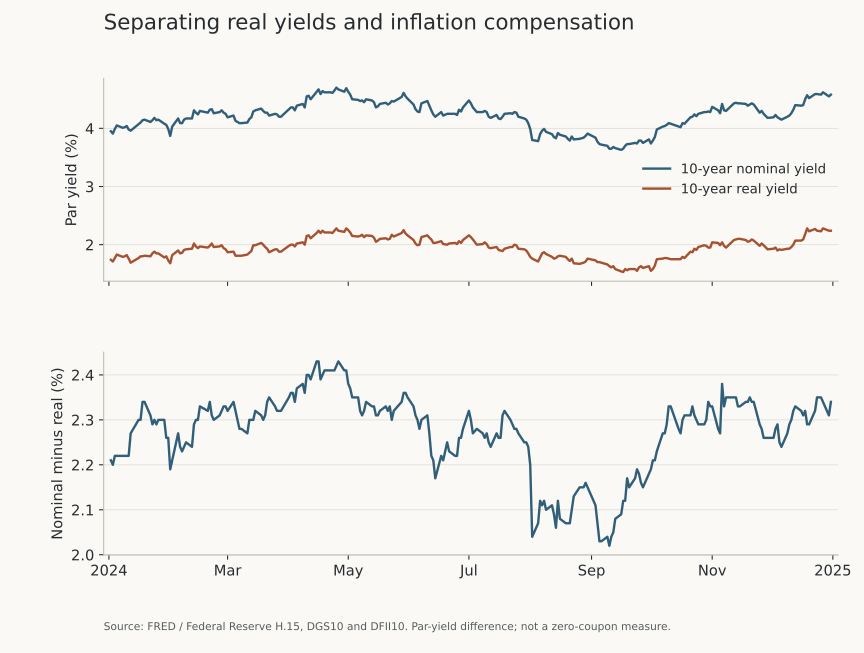
This is an accounting decomposition. It does not identify which news caused the moves, and “real yield” itself includes more than the expected path of inflation-adjusted short rates. Changes in real term premium and TIPS liquidity can affect the quoted real yield.
Breakevens include a price for uncertainty
Investors in nominal Treasuries bear the risk that inflation will reduce the purchasing power of fixed payments. Their required compensation can include an inflation risk premium. Investors also place different values on the liquidity of nominal Treasuries and TIPS.
The Federal Reserve's research on the TIPS yield curve discusses both effects. Its data notes caution against interpreting breakevens as estimates of inflation expectations.
The direction of the liquidity effect matters. If investors demand an additional yield premium to hold less-liquid TIPS, the real yield rises and the measured breakeven falls, even with unchanged expected inflation. Conversely, a stronger preference for liquid nominal Treasuries can lower nominal yields and compress the spread.
The 25 bp widening in this example therefore supports the statement that market-priced inflation compensation increased. Assigning all 25 bp to expected CPI inflation would require more evidence, such as surveys, inflation swaps and a model that separates the relevant premiums.
The cash-flow details matter for an actual position
TIPS protect against a specific inflation index. Treasury uses the non-seasonally-adjusted CPI-U, with a reference index based on the third preceding calendar month and daily interpolation. Treasury's TIPS guide explains the lag, and its CPI and index-ratio dataset provides the inputs for cash-flow calculations.
That creates several practical checks:
- Indexation and seasonality. A short-horizon carry estimate needs the bond's reference CPI path. One seasonally adjusted monthly CPI release cannot be inserted into the index ratio without conversion and timing adjustments.
- Settlement. Invoice value depends on the index ratio as well as the quoted real price and accrued interest. A hedge sized from unadjusted face value can misstate dollar risk.
- The maturity floor. Treasury repays at least original principal at maturity. That protection does not guarantee a secondary-market buyer's purchase price or prevent mark-to-market losses before maturity.
- Cash-flow matching. Two securities labeled “10-year” can have different maturity dates, coupons and durations. Matching maturity labels alone does not neutralize interest-rate exposure.
The par-yield difference used here is convenient for monitoring. A precise forward inflation calculation or relative-value trade needs consistent zero-coupon curves or security-level pricing. Subtracting two par yields does not create a tradable, cash-flow-matched package.
Choose the exposure that matches the view
A long TIPS position retains real-duration risk. TIPS can lose price value if real yields rise, even while their principal accrues with inflation. The late-2024 increase in real yields shows why an inflation-protection label is insufficient to explain short-horizon returns.
A view on widening inflation compensation instead points toward analyzing a long-TIPS, short-nominal package with comparable dollar sensitivities. The return then also depends on inflation accrual, coupon differences, financing, liquidity and imperfect hedging. Rising realized inflation alone does not guarantee that a short-horizon package earns a profit.
For a daily note, I would report the nominal yield move, real yield move and breakeven change together, then distinguish the measured decomposition from the proposed explanation. In this sample, the measured conclusion is specific: real yields accounted for 70 bp of the 95 bp nominal increase over the selected late-2024 interval.
Reproduce the analysis
The Python script calculates the difference from same-date observations and verifies that the components reconcile. The episode table contains the changes cited above. Download the research package for raw data, charts and methodology. The historical endpoints illustrate a decomposition, not an out-of-sample trading signal.
Related: two ways the Treasury curve can steepen.