SVB, Credit Suisse, and a very strange March
Reading about Silicon Valley Bank, I keep getting stuck on one detail: a bank could hold a large portfolio of government-backed securities and still get into terrible trouble because of that portfolio. Then, as the banking crisis grew, investors bought Treasuries and their yields fell.
Government bonds appear on both sides of the story. That makes March 2023 a much more interesting lesson than “higher rates hurt banks.” I want to understand how an asset can contribute to a funding problem at one institution and provide protection for someone else a few days later.
A bond can wait. A depositor might not.
The Federal Reserve's review of SVB's failure describes a combination of interest-rate risk, concentrated customers and reliance on uninsured deposits. Those risks reinforced each other.
As rates rose, the market value of securities bought at lower yields fell. Meanwhile, customers in the technology and venture-capital ecosystem needed cash and drew down deposits. The bank's assets and its customers' willingness to leave money on deposit were moving in an uncomfortable direction together.
On March 8, SVB announced that it had sold about USD 21 billion of available-for-sale securities, recognized a USD 1.8 billion after-tax loss, and planned to raise USD 2.25 billion of capital. The next day, depositors withdrew more than USD 40 billion. California's regulator closed the bank on March 10.
That sequence helps me separate three ideas I had been tempted to compress into the word “safe”: getting repaid at maturity, maintaining the asset's market value before maturity, and having cash available when a liability comes due.
A Treasury or agency mortgage-backed security can have low credit risk and substantial duration risk. A bank cannot make that duration disappear by intending to hold the security. Nor can accounting treatment make depositors wait until the bonds mature.
SVB's particular deposit base mattered, too. A concentrated group of companies and investors can face similar cash needs and react to the same information. Modeling each deposit as though its owner makes an independent decision would miss an important part of the problem.
The two-year yield gives the week another dimension
The Treasury data show how fast the expected policy environment changed.
| Observation | 2-year yield | 10-year yield |
|---|---|---|
| March 8, 2023 | 5.05% | 3.98% |
| March 10, 2023 | 4.60% | 3.70% |
| March 13, 2023 | 4.03% | 3.55% |
Source: Federal Reserve H.15 via FRED, DGS2 and DGS10. These are daily constant-maturity par yields, not intraday highs or lows.
From March 8 to March 13, the two-year yield fell 102 basis points. A basis point is one-hundredth of a percentage point. The 10-year fell 43 bp, so the 2s10s curve steepened by 59 bp while remaining inverted. The two-year's Friday-to-Monday decline alone was 57 bp.
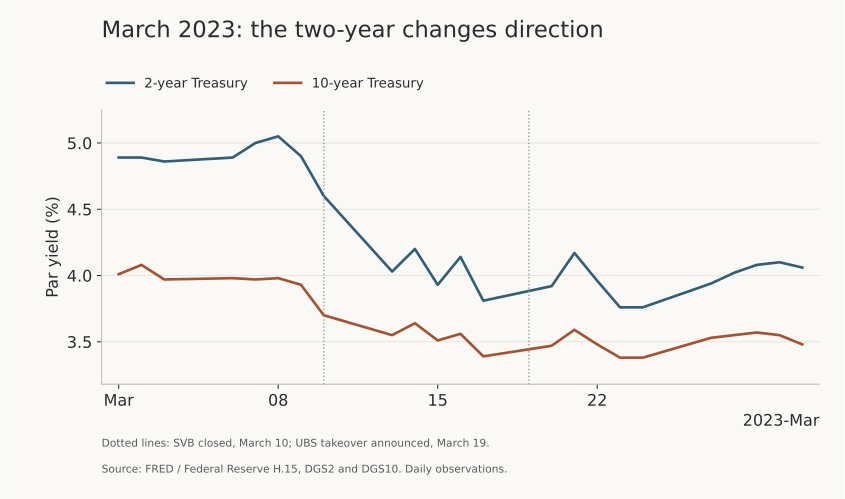
I read the larger front-end move as consistent with investors reconsidering the path of Fed policy as banking stress threatened credit availability and economic activity. Demand for liquid government securities also mattered. The yield series alone cannot tell me how much to assign to each explanation.
There is a useful complication: on March 22, the Fed still raised its policy target by 25 bp. A large decline in the two-year did not require an immediate rate cut. Investors were pricing a path extending well beyond the next meeting, alongside risk and liquidity premiums.
Credit Suisse adds a different set of questions
On March 19, Swiss authorities announced the UBS takeover of Credit Suisse, supported by official liquidity measures. FINMA said it had monitored Credit Suisse intensively for months and that the bank's efforts had failed to restore confidence.
That history matters. Credit Suisse had its own longstanding problems. Describing the two banks as interchangeable examples of a Treasury-duration loss would flatten the story beyond recognition. The connection was the vulnerability of a financial institution once customers and counterparties lost confidence in its ability to keep funding itself.
The Swiss announcement also ordered the write-down of roughly CHF 16 billion of Credit Suisse's AT1 capital instruments. Those were loss-absorbing bank securities, with contractual and legal features that require separate analysis. They were not government bonds. For a rates student, this is a reminder to read the actual instrument terms before deciding what a headline implies for the broader market.
I find the cross-border part especially interesting. A US rates analyst can wake up to a Treasury market responding to decisions made by Swiss regulators over the weekend. Following the US data calendar would have covered only part of that week's information.
The Fed had more than one instrument to use
On March 12, the Fed announced the Bank Term Funding Program. Eligible institutions could borrow for up to a year against qualifying securities, including Treasuries and agency securities, with the collateral valued at par for the program.
That addressed the pressure to sell eligible assets into the market to obtain cash. It did not turn the loan into income or erase the borrower's obligations. The distinction between lending against an asset and changing the asset's market value is worth keeping straight.
The Fed could therefore provide a funding backstop while continuing to raise its policy rate. I find that combination more instructive than trying to label the whole response “tightening” or “easing.” The tools addressed different problems.
The question I leave this episode with concerns liabilities: how should an analyst estimate deposit stability when customers share investors, industries and group chats? Duration calculations are essential, but March 2023 makes me want to put the funding assumptions beside them and read both twice.
Part of my Treasury market-history notebook. The data and Python package contains the chart inputs and dated yield changes. This is a retrospective reading of the evidence, not a claim that the outcome was predictable in real time.
Next: the Fed scares of 2013 and 2018, or the March 2020 dash for cash.