The repo market's expensive Tuesday
An overnight loan backed by a Treasury sounds like it should be among the less dramatic transactions in finance. The lender has collateral. The borrower needs cash for a day. There is no ten-year earnings forecast to argue about.
Then I look at September 17, 2019. SOFR, the benchmark for overnight borrowing against Treasury collateral, reached 5.25%, up from 2.43% the previous business day. The Fed's target range for its overnight policy rate was 2.00–2.25%.
I want to know how those numbers could exist on the same day. The answer involves corporate taxes, Treasury issuance and the location of cash inside the financial system. This is the first episode in this notebook that has made a tax-payment calendar seem like promising reading material.
First, these are different overnight rates
The New York Fed calculates SOFR from Treasury repo transactions. A repo is, in economic terms, a collateralized loan: one party provides cash, receives securities, and agrees to return those securities when the cash plus financing charge comes back.
The effective federal funds rate, or EFFR, measures a different market: unsecured overnight borrowing of dollar funds among eligible institutions. The Fed sets a target range for the federal funds rate. SOFR is not required to sit inside that range, although the markets normally influence one another.
| Transaction date | SOFR | EFFR | Fed target range |
|---|---|---|---|
| September 16 | 2.43% | 2.25% | 2.00–2.25% |
| September 17 | 5.25% | 2.30% | 2.00–2.25% |
| September 18 | 2.55% | 2.25% | 2.00–2.25% |
These are 2019 observations from FRED: SOFR, EFFR, and the target lower and upper bounds. SOFR and EFFR refer to the transaction date and are published on the following business day.
SOFR's 282 bp jump was striking. The smaller EFFR move mattered for another reason: at 2.30%, it exceeded the top of the Fed's target range. The disturbance had reached the rate the Fed was trying to control.
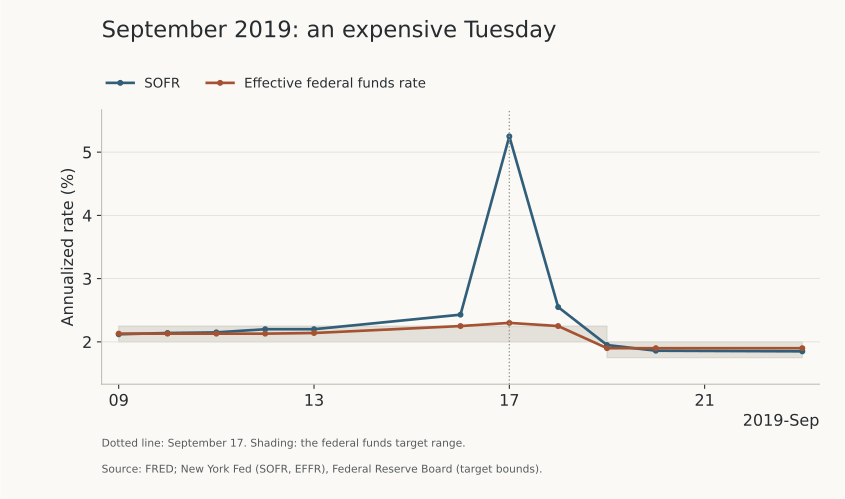
One small but useful convention check: 5.25% is an annualized rate. A borrower did not pay 5.25% of the loan principal for a single day.
Follow the cash through the calendar
The New York Fed's study, The Market Events of Mid-September 2019, identifies two coinciding events: corporate tax payments and the settlement of substantial Treasury issuance.
Corporate tax payments move funds toward the Treasury's account at the Fed. Before the government spends those balances back into the economy, that transfer can reduce banking-system reserves and the cash available from some money-market lenders.
Treasury settlement creates another cash need. Buyers have to pay for the securities. Dealers that acquire inventory may need to finance it in repo. Net issuance can therefore both drain reserves as cash reaches the Treasury and increase demand for repo financing as investors take delivery of bonds.
The combination puts pressure on the two sides of the funding market: less cash offered by some lenders and more cash sought by borrowers.
That gets me part of the way to understanding the spike. The harder question is why someone else did not move cash into the market and take advantage of the higher rate.
Aggregate reserves are only the start of the answer
“There are reserves in the system” does not tell me who holds them, how much each bank wants to retain, or what it costs to move them to the borrower who needs funding.
The New York Fed researchers examine whether reserves had become scarce relative to some institutions' desired holdings. They also examine frictions that could prevent reserves from moving efficiently between institutions, even if the aggregate amount looked adequate. Their evidence points to higher intermediation costs at some large dealers as another part of the episode.
I find this useful because it puts a limit on a simple arbitrage argument. A bank looking at an attractive lending rate still has liquidity preferences, internal constraints and costs. The existence of a spread does not guarantee that enough balance-sheet capacity will appear to close it at once.
This also helps distinguish the episode from a loss of faith in the Treasury collateral itself. The question was the price and availability of cash against that collateral. A good asset does not guarantee cheap financing at a particular hour.
The Fed lent against securities
On September 17, the New York Fed announced an overnight repo operation of up to USD 75 billion. It offered cash to primary dealers against eligible collateral to help keep the federal funds rate within its target range.
That was temporary financing. It differed from an outright asset purchase designed to leave a security on the Fed's balance sheet for a longer period. The distinction matters when reading a headline about the Fed “injecting liquidity”: I want to know the transaction, its maturity and its purpose.
Funding rates retreated after the September 17 spike, although the surrounding period also included a Fed policy-rate change and further operations. The three observations in the table are a description of the episode, not a clean experiment measuring the effect of a single intervention.
For Treasury strategy, my takeaway is practical. A relative-value position funded overnight depends on tomorrow's financing as well as today's bond price. I would want a calendar of tax dates and settlement flows beside the usual yield curves, plus a way to see whether higher funding costs were concentrated in one market or spreading across several.
I started with a question about a rate spike. I finish with a much longer list of people whose cash needs I want to understand.
The research package includes the raw rate series, the aligned observations, and Python code for the chart. For the return arithmetic behind funding assumptions, see Treasury carry after the funding bill.
Next in the notebook: the much broader dash for cash in March 2020.